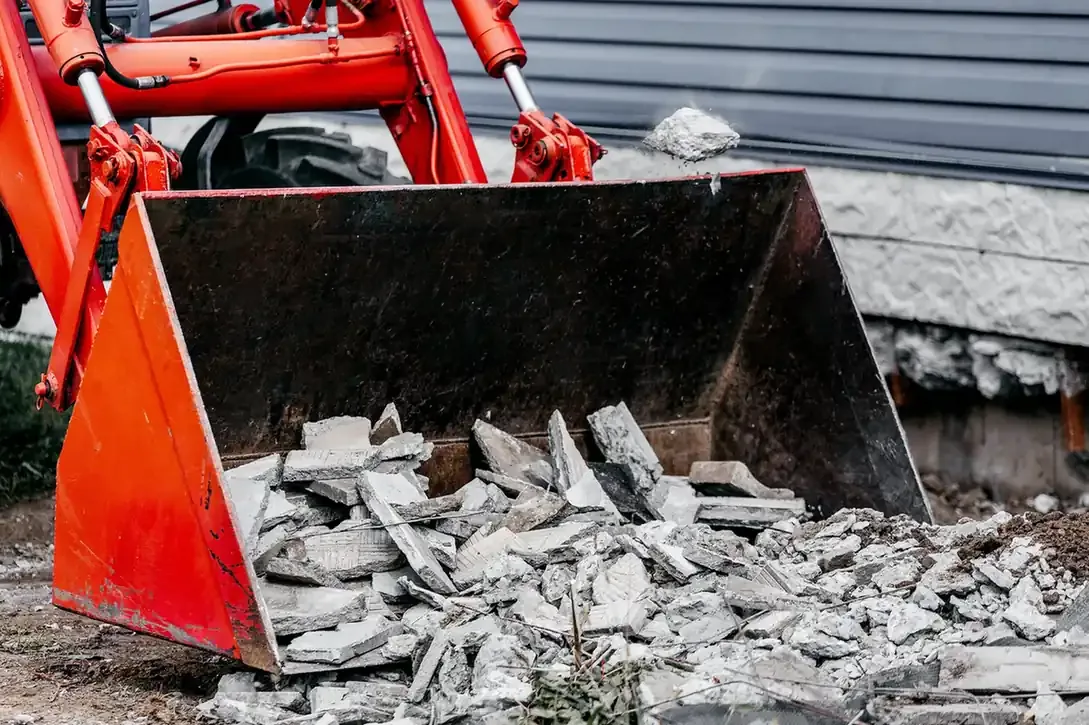
A 40 yard skip is not suitable for every heavy waste load because its cubic capacity does not establish how much weight it can safely or legally carry. Dense materials such as concrete, brick and rubble can make a large container too heavy long before it is full.
For construction and industrial sites, the important decision is whether the container can accommodate both the physical volume and the expected load weight. A smaller or differently configured container may be more appropriate for heavy materials, even when a larger skip appears to offer better capacity.
What does 40 yard capacity actually mean?
A 40 yard skip is generally described by its approximate internal volume of 40 cubic yards, equivalent to about 30.6 cubic metres. That measurement describes space, not a permitted payload.
The maximum usable load depends on the container’s design and weight, the collecting vehicle, lifting equipment, applicable road limits and the waste being carried.
Two skips with the same nominal capacity may therefore have different operational load restrictions. A buyer should not assume that the full container volume can be used for every material.
Why concrete waste changes the calculation
Concrete, paving slabs, masonry and compacted rubble are relatively dense. They occupy much less space for a given weight than cardboard, lightweight packaging or many bulky fixtures.
As a simple illustration, if a waste material has a bulk density of two tonnes per cubic metre, filling 30 cubic metres would produce approximately 60 tonnes of material. This is a calculation demonstrating the relationship between volume and mass, not an expected skip payload or a universal density for rubble.
Actual rubble density varies according to material composition, particle size, void spaces and moisture. The practical consequence remains the same: a container can reach its allowable weight while considerable empty space remains.
Bulky and comparatively light waste
Large quantities of lightweight packaging, timber offcuts or certain non-hazardous bulky materials may occupy substantial space without creating an equally large load weight.
These are the situations where a high-volume container can be useful, provided the waste types are accepted and the resulting load remains within the collection limits.
Dense demolition materials
Broken concrete, bricks, kerbstones and paving waste usually need a weight-led selection. A smaller container or a series of collections may be more suitable than trying to use all the volume available in a 40 yard skip.
For projects involving several materials, the site’s construction waste management information provides broader context on construction waste streams.
Waste classification is a separate decision
The weight of a load does not determine its hazardous status. In England, the Environment Agency’s construction and demolition waste classification guidance distinguishes uncontaminated concrete from concrete and masonry containing hazardous substances.
For example, uncontaminated concrete is listed under code 17 01 01, while relevant concrete, brick, tile and ceramic waste containing hazardous substances falls under 17 01 06*.
This distinction can affect which materials may be collected together and which receiving facilities can accept the load. It cannot be resolved merely by selecting a larger container.
How to choose a suitable container
Before selecting a roll on roll off skip, establish:
- The principal waste materials and whether heavy rubble forms most of the load.
- The estimated volume of waste requiring removal.
- The expected load mass, using reliable material quantities or project information where available.
- Whether the materials are clean, mixed or potentially contaminated.
- The permitted loading limit for the proposed container and collection arrangement.
- Whether a smaller container or multiple collections would provide a more suitable solution.
For mixed construction waste, material proportions are particularly important. A load described as general demolition waste could contain mostly lightweight timber, mostly heavy masonry or a combination that changes throughout the project.
Matching capacity to the actual waste
A 40 yard skip is a volume option rather than a universal heavy-duty solution. The right size is the one that accommodates the waste without exceeding the permissible load weight or creating an unsuitable mixture of materials.
When comparing roll on roll off skip hire options, describe the waste composition and anticipated weight alongside the required volume. This gives a more useful basis for container selection than cubic capacity alone.